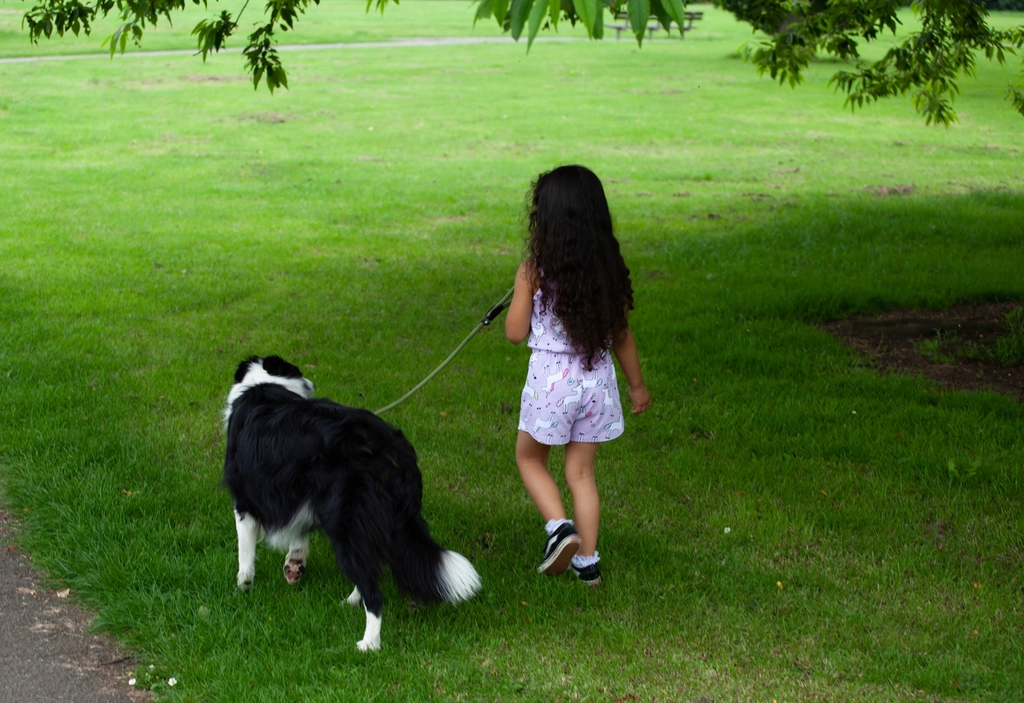
Our editor’s daughter was four when she decided the family beagle, Moss, needed to hear every picture book she owned. She couldn’t read yet. That didn’t stop her. She would sit cross-legged on the hallway rug, hold the book upside down about half the time, and invent the story from the pictures while Moss lay with his chin on her knee and sighed at the sad bits.
He never once got up and left. For a beagle, who will normally abandon anything for a smell in the next room, that is about as close to a declaration of love as you get.
Most families with a dog and a child have a story like this. Here are a few more, and some plain advice on keeping those friendships safe.
The dog who waited at the window
A reader in Leeds told us about her Border Collie, Fen, who worked out the school timetable within about a fortnight of her son starting Year 1. At 3.10 every weekday Fen would leave whatever she was doing and go and sit at the front window. Bank holidays confused her badly. She would sit there anyway, looking personally let down.
Dogs are very good at routines, and a child’s day is full of them. The rustle of a lunchbox, the sound of a particular pair of wellies being kicked off, the bedtime bath. A dog builds a picture of a child out of all those small, repeated things, and before long the child is simply part of how the dog understands the house.
Why kids and dogs click
Part of it is that they want similar things. Snacks. Running about. Lying on the floor. A child at eye level with a dog is far less intimidating than an adult looming over it, and kids are usually happy to throw a ball for the fortieth time, which most adults are not.
There’s also something in the way a dog listens. A seven-year-old who stumbles over words reading to a teacher will often read happily to a dog, because the dog doesn’t correct anything. Some libraries run reading sessions with calm, assessed dogs for exactly this reason.
And for children who find people tiring or confusing, a dog can be a gentler kind of company. Dogs are honest. A wagging tail means one thing, a stiff body means another, and a child who learns to read those signals is learning something useful about paying attention to others.
A small boy and a very large dog
One family we know has a Newfoundland called Bear, roughly 60 kg of drool and patience, and a son, Alfie, who was a nervous toddler. Alfie didn’t like loud noises, busy rooms or new people. He did like Bear.
When visitors came round, Alfie would go and stand next to Bear and hold a fistful of fur. Bear, who understood the job without being taught it, would stay completely still until Alfie let go. His mum says the dog did more for Alfie’s confidence in that first year than any amount of coaxing from the adults.
It’s a lovely story. But Bear is an unusually calm, well-socialised dog, and his parents were in the room every single time.
Supervision, every time
Even the softest family dog is still a dog. Most bites to young children come from a dog the child knows, often the family’s own, and often during an ordinary moment that went slightly wrong: a hug, a grab at a toy, a face pushed too close to a sleeping dog.
The simple rule for young children, roughly under eight, is that they are never left alone with a dog. Not for “just a minute” while you answer the door. If you can’t watch, separate them with a baby gate, a closed door or a crate the dog is happy in. That isn’t a sign you don’t trust your dog. It’s how you keep your dog from ever being put in a position where it feels it has to defend itself.
Active supervision means actually watching, too. Being in the kitchen while the kids and dog are in the lounge doesn’t count.
Teaching kids how to meet a dog
Children are rarely taught this, and it makes a huge difference. These are the habits worth practising at home:
- Always ask the owner first, every time, even if it’s a dog you’ve met before.
- Stand still and let the dog come to you. If it doesn’t, that’s fine, it’s saying no thanks.
- Stroke the side of the neck or the chest, not the top of the head.
- No hugging, no kissing faces, no climbing on dogs. Kids hug to show love. Most dogs just put up with it.
- Leave a dog alone when it’s eating, sleeping, chewing something, or has taken itself off to its bed.
- If a strange dog runs up, “be a tree”: stand still, hands folded in, look at your feet.
It also helps to teach kids what an unhappy dog looks like. Yawning when it isn’t tired, licking its lips, turning its head away, showing the whites of its eyes, freezing, or tucking its tail. A growl is a warning, and a useful one. Never punish a dog for growling, or you teach it to skip the warning next time.
Giving the dog somewhere to escape
Every dog in a house with children should have a spot that belongs only to it. A bed in a quiet corner, a crate with the door open, a room behind a gate. The rule for the kids is simple: when the dog goes there, it’s off limits.
Moss’s spot was under the stairs. When the reading sessions went on a bit long, he’d quietly get up and take himself there, and the four-year-old learned to say “Moss is having a break” and carry on reading to a teddy instead. That’s exactly how it should work.
Jobs that build the bond
Older children can take on real responsibilities, with a grown-up checking. Measuring out breakfast, filling the water bowl, practising “sit” and “wait” with a few bits of kibble, helping with the brush. A ten-year-old who has taught the dog to give a paw will be insufferably proud for a week, and the dog will start following that child around in a new way.
Just keep it realistic. A child promising to do all the walks is a lovely thought. In practice, the 7 a.m. walk in January usually ends up being yours.
Moss is grey around the muzzle now, and the four-year-old is a teenager who rolls her eyes at most things. Not at him, though. Some nights she still sits on the hallway rug with her phone, and he still comes over and puts his chin on her knee.